.png)
Marcus, an IT and operations director at an urban community health network, sat across a table from a enterprise software sales representative. The representative held up a sleek, glossy brochure filled with promises about cloud architecture, enterprise scale, and user management. Marcus listened patiently, then asked a simple question: "Can you show me your written public commitments regarding client data ethics, trauma-informed privacy, and constituent rights?"
The sales representative blinked, shifted in his chair, and leaned back. He admitted that while his company had standard corporate terms of service and standard end-user agreements, they had no formal, public data ethics charter.
Marcus's frustration is shared by leaders across the social sector. Non-profits are routinely asked to trust software vendors with their most sensitive constituent stories. Yet, when agencies examine the fine print, they find legal disclaimers designed to protect the vendor, not the vulnerable human beings seeking care.
Sector research from NTEN on non-profit technology governance reveals that over 85% of commercial software vendors serving non-profits operate without any published data ethics commitments or constituent privacy charters. They ask social service leaders for unearned trust, offering only boilerplate legal language in return.
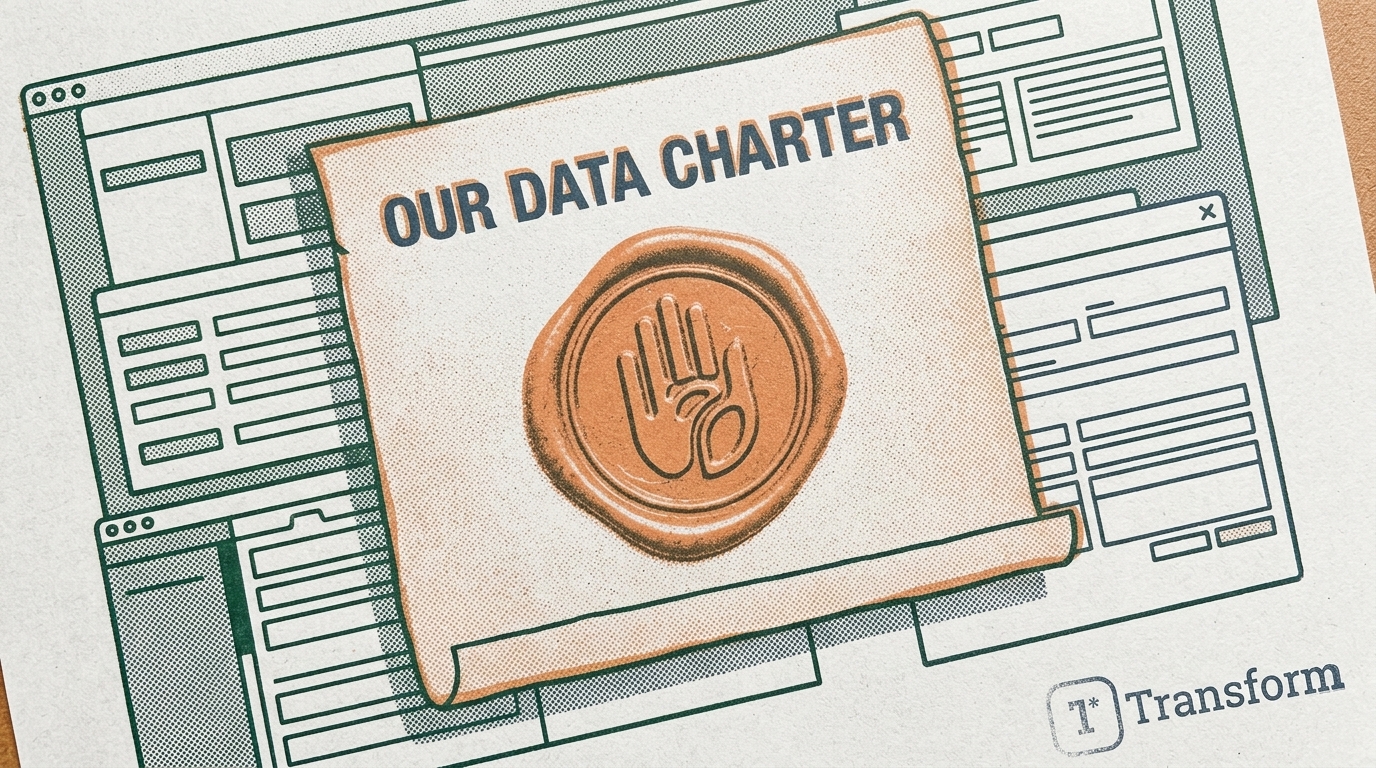
At Transform, we believe the sector deserves proof, not sales promises. Born inside a frontline charity before growing into a purpose-built SaaS platform, we authored the People-First Intake Charter. Here is how our public commitments translate directly into product decisions inside our software.
When agencies rely on flat files or legacy tools, they often run into severe social service data collection problems. Systems encourage caseworkers to collect excessive, non-essential client details just in case a funder asks for them later.
Our charter commits us to collecting only the minimum data required to deliver care and satisfy essential reporting. Inside Transform, this commitment shapes every intake interface:
For Canadian organizations, data privacy is not a marketing catchphrase. It is a fundamental responsibility to community safety.
Our charter pledges complete adherence to Canadian privacy frameworks like PIPA and PIPEDA. In our product, this commitment shows up in our physical and logical architecture:
Technology should never add to the mental toll of frontline work. When software is difficult to use, it drives staff turnover and caseworker exhaustion.
Our charter pledges that our platform must actively work to reduce frontline worker burnout. We turn this pledge into software through built-in administrative tools:
If your agency is currently evaluating an ETO software alternative, an Apricot software alternative, a Bonterra alternative for nonprofits, or a ServicePoint alternative, you should not have to compromise on data ethics.
We published our People-First Intake Charter publicly at share.islamicfamily.ca/datacharter as an open promise to the sector. It is our binding pledge that our technology will always honor human dignity, protect frontline workers, and safeguard constituent trust.
Would you like to read the full charter or schedule a case management software demo nonprofit teams can trust? Connect with our Edmonton-born team today.
Schedule your free demo today and experience the Transform difference.