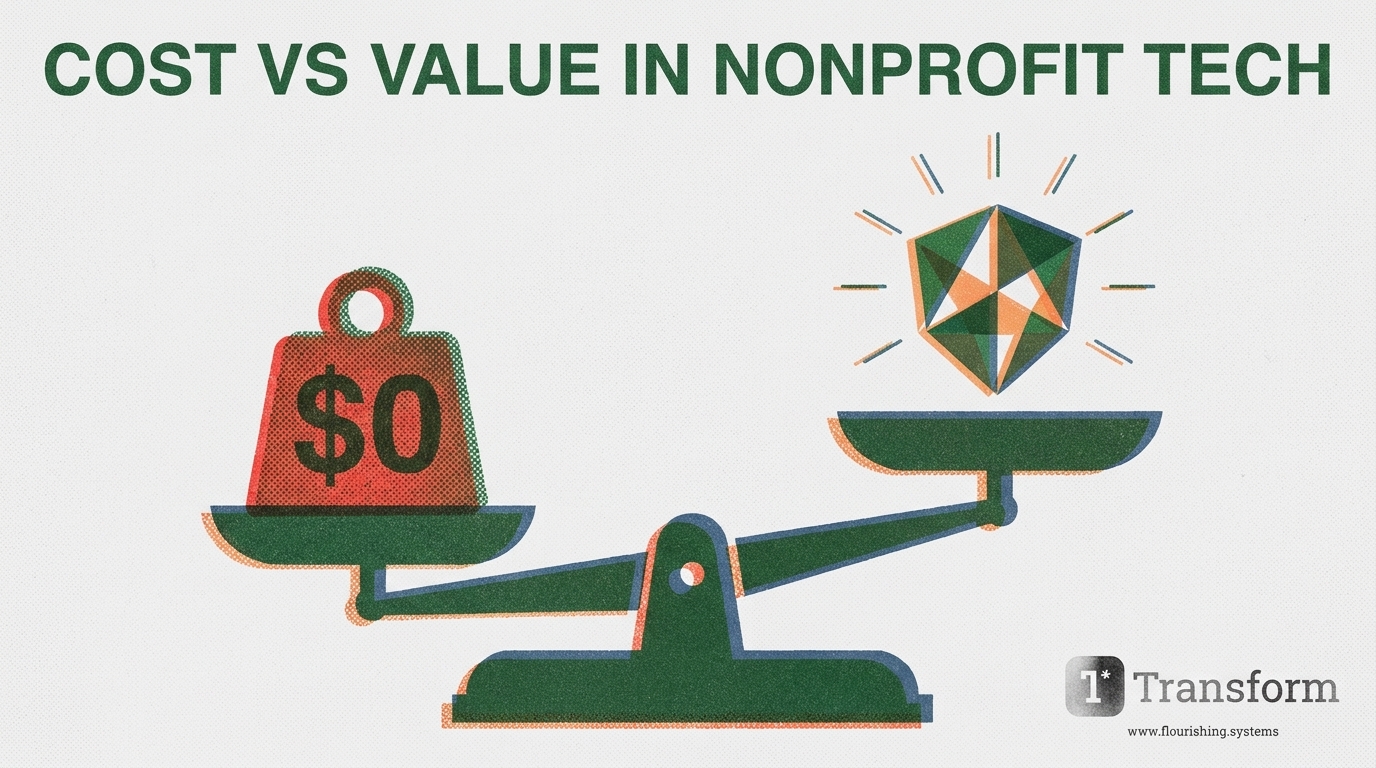
Sarah, an Executive Director at an urban youth services agency, proudly presented her annual budget to the board. Under the line item for "IT & Digital Tools," the figure read $0. For years, the agency had survived on donated desktop computers, free consumer spreadsheet software, and basic email accounts. Sarah considered this $0 budget a badge of financial stewardship—proof to funders that every single dollar was going directly to program delivery.
Then, Sarah spent a week tracking operational workflows across her 15-person frontline team.
She discovered that caseworkers were spending an average of 14 hours every week copy-pasting client notes across free spreadsheets, manually tracking shelter beds, and formatting funder metrics. That amounted to 210 staff hours every week—the equivalent of over five full-time salaries spent purely on administrative manual labor.
Far from saving money, Sarah’s "$0 tech budget" was secretly costing her agency over $150,000 a year in lost productivity, staff turnover, and administrative fatigue.
For decades, the non-profit sector has been trapped in the "overhead myth"—the destructive belief that effective charities should spend virtually nothing on infrastructure, technology, or operational systems.
When non-profits treat technology as an overhead expense rather than a core program driver, they end up paying a heavy hidden tax:
According to research on non-profit technology investments from the Stanford Social Innovation Review, every dollar invested in modern, domain-specific case management software yields up to four dollars in operational time savings and increased capacity.
Shifting from a $0 tech mindset to a high-ROI digital strategy requires evaluating software based on total value delivered, rather than upfront software costs.
When evaluating a new CRM implementation plan or upgrading legacy systems, non-profit leadership should calculate ROI across three major operational pillars:
If a platform saves a caseworker just 5 hours a week on administrative documentation, a team of 20 workers gains 5,200 hours of direct client care every year. The cost of the software is instantly offset by the dramatic increase in service capacity.
Manual grant reporting eats up weeks of executive time. Modern case management software for nonprofits automatically maps daily frontline interactions into funder logic models and outcome frameworks, turning a 20-hour reporting crunch into a simple export.
Investing in dedicated non-profit case management software Canada organizations can rely on guarantees Canadian data residency and strict privacy compliance, securing constituent trust and protecting the agency’s reputation.
An effective CRM implementation plan is not an administrative burden or an unnecessary capital expense—it is a strategic investment in operational sustainability.
Transform was built from inside a frontline charity to break the cycle of technology starvation in our sector. Designed as an ETO software alternative, an Apricot software alternative, and a Bonterra alternative for nonprofits, Transform delivers modern, human-centered technology that frontline staff actually love using.
By investing in technology that respects frontline time and protects client dignity, non-profit leaders can move past the $0 tech myth and build resilient, sustainable organizations.
Are you ready to calculate the true cost of your current tech stack? Connect with our Edmonton-born team today to review a tailored implementation plan for your agency.
Schedule your free demo today and experience the Transform difference.