.png)
In the world of social services, we often talk about the "big" hurdles: funding cuts, shifting policy, or the sheer volume of need in our communities. But when we look at why frontline workers are exhausted and why clients feel like just another number in a spreadsheet, the real culprit isn't a lack of heart. It is the Status Quo.
We’ve all been there. We stay with a system that is "good enough" because the thought of moving data, retraining staff, and switching workflows feels like an mountain we aren't ready to climb. At Transform, we understand that hesitation. We were born as a charity before we grew into a technology company. We’ve lived the reality of patchwork systems held together by sticky notes and sheer willpower. But here is the hard truth: the comfort of the familiar is quietly stealing the impact you were meant to make.
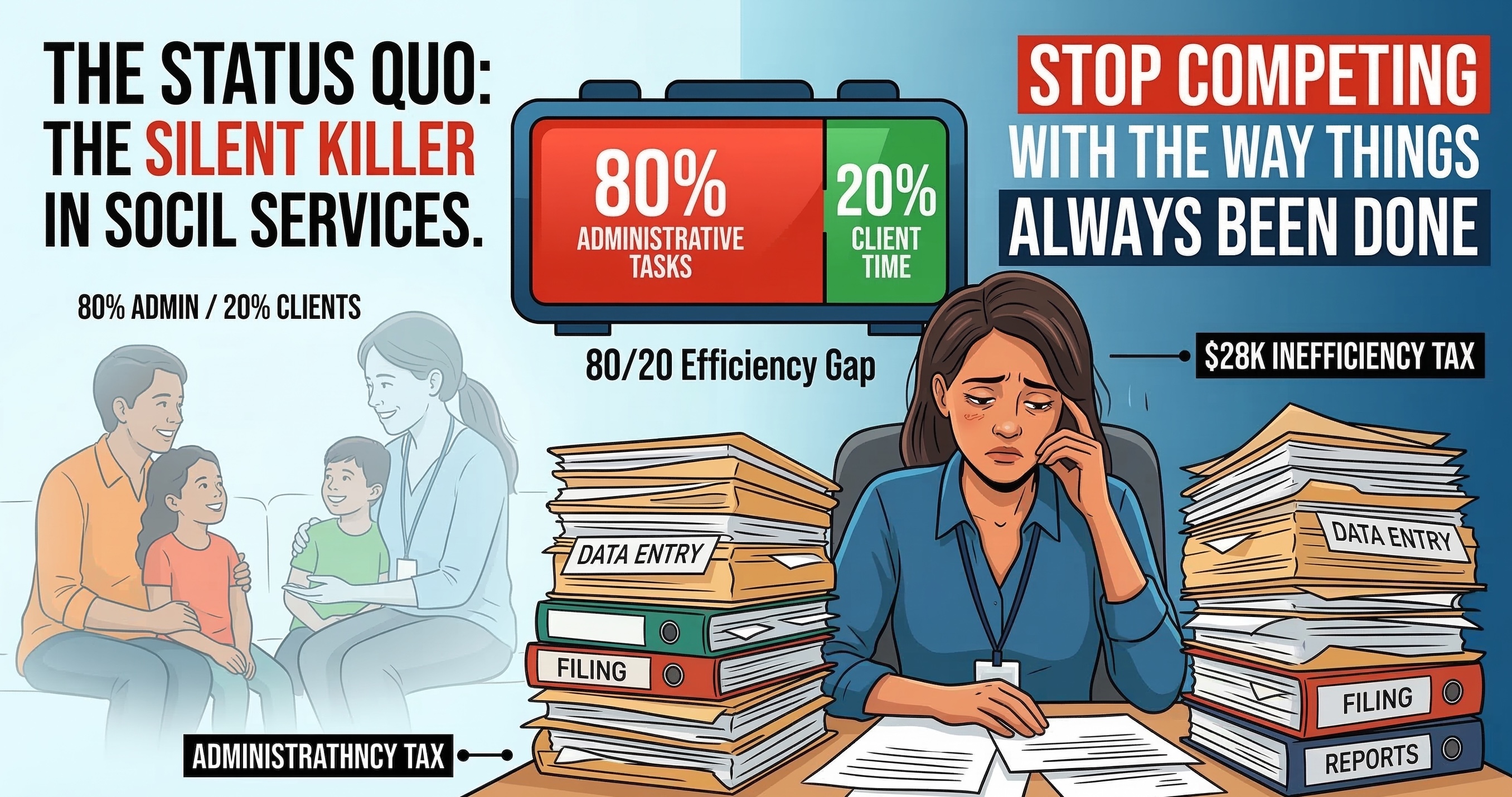
The Status Quo has a way of turning dedicated social workers into highly overqualified data-entry clerks. Research from the British Association of Social Workers (BASW) found that social workers spend nearly 80% of their time on administrative tasks. That leaves a mere 20% for face-to-face work with families and individuals.
Think about that for a second. If your team works five days a week, the Status Quo is effectively "stealing" four of those days. Your clients are getting one day of focused care, while the other four are lost to the black hole of manual entry and filing.
There is a common misconception that sticking with paper or basic spreadsheets is "free" because there is no new line item in the budget. In reality, manual processes are one of the most expensive ways to run an organization. A 2025 survey by Parseur found that manual data entry costs companies an average of $28,500 per employee annually.
For a social service agency, this is a massive drain on resources. That $28,000 isn't just money; it represents the high-value professional labor of a caseworker whose expertise is being wasted on repetitive tasks. When we choose the Status Quo, we are essentially paying a premium for inefficiency.
Beyond the numbers, there is a human cost. When our tools are extractive and disconnected, we force clients to retell their stories of trauma over and over again because the data isn't centralized. We call this administrative retraumatization.
It takes a toll on the staff, too. Over 70% of social workers report that administrative burdens prevent them from spending adequate time with clients. This leads to a sense of moral injury. People don't enter this field to fight with software; they enter it to change lives. When the system prevents them from doing that, burnout is inevitable. In fact, nearly half of the social workers in our sector are currently experiencing burnout. The Status Quo isn't just slow, it's driving away your most talented, mission-driven people.
Psychologists call it "Status Quo Bias" the human tendency to fear the potential loss of a change more than the guaranteed gain of a new system. In high-stakes environments like child welfare or addiction recovery, treating the current state as a "safe" baseline is a risk.
If your data is scattered across five different spreadsheets and legacy databases, you aren't just inefficient. You are audit-vulnerable. You are at risk of a data breach. Most importantly, you are missing the "single source of truth" needed to actually prove your impact to funders.
The rules of social work technology are being rewritten. We don't have to accept a world where we spend more time with screens than with people. It’s time to stop competing with other priorities and start addressing the real competitor: the way things have always been done.
Schedule your free demo today and experience the Transform difference.